Mattelson, Meisel, and Magee: Amsel's art school friends share their stories
Richard Amsel’s time at the University of the Arts (then known as The Philadelphia College of Art) played an important part of his formative years. He attended there from 1965 to 1969.
Several of Amsel’s classmates would go on to very successful creative careers of their own. Among them were the Quay Brothers, Stephen Quay and Timothy Quay – twin artists, filmmakers, and animators, acclaimed for their work on such films as Street of Crocodiles (1986), which was reportedly a favorite of Terry Gilliam. While I haven’t been able to interview them, I’ve interviewed others whose testimonials shed light on Richard Amsel’s talent and personality during that time.
Revisiting their footage as I edit, I now realize an hour-long chapter could easily be dedicated to just these art school years alone. I’m also taken back to my own personal experiences shooting that footage so long ago, especially in 2017. That year I repeatedly visited my ailing father in Pennsylvania, then travelled from state to state for filming. All my equipment was stuffed alongside me within little, economy rental cars. I must have driven over a thousand miles. I lost track of how many times, faced with a sharp turn or a sudden need to slam the break, a cup of coffee or miscellaneous junk would spill over, onto my lap or the floor.
Among the UoA alum I’ve filmed were classmates Rhona Gross Weiss and Alice “Bunny” Carter, and a teacher, the late John “Jack” Warren Freas, all of whom I’ve previously written about in some capacity.
Yet I’m embarrassed to say I’ve been late to the game on writing about a number of others, each of whom have provided invaluable testimonials.

First among them is Marvin Mattelson, who I interviewed at his home studio in New York back in 2017. Mattelson was particularly close to Amsel during their school days, where they each stood out from their illustration classmates. Mattelson is known for his movie poster to Martin Scorsese’s AFTER HOURS, and the famous album cover for the 1994 Chant album by The Benedictine Monks of Santo Domingo de Silos. He continues painting today, creating fine art portraits, and offering master classes in oil portraiture. Any student of fine art would consider themselves lucky to have him as a teacher.
Mattelson’s interview was especially powerful, as he recalled attending Amsel’s funeral, and sharing heartbreaking words with his grieving mother, Beatrice.
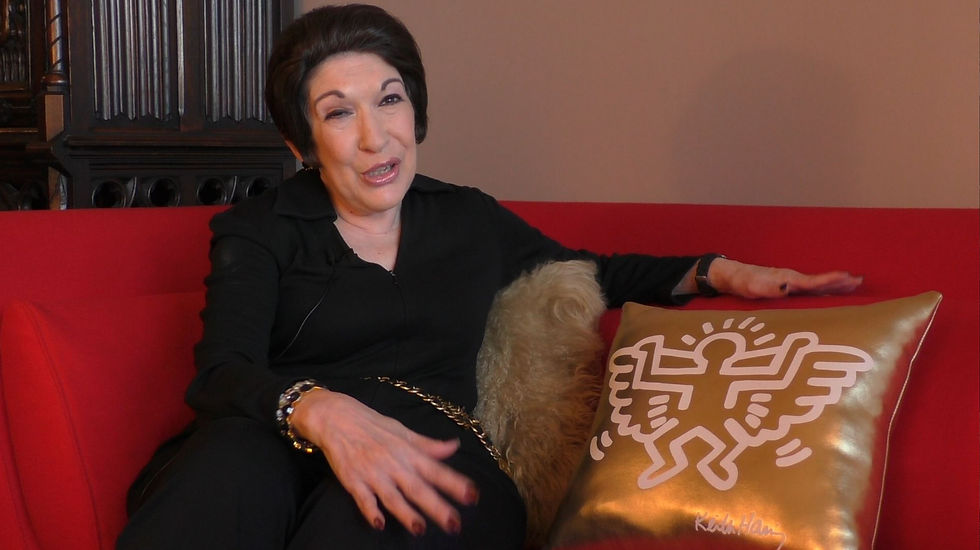
And then there’s Ann Meisel, another artist and close friend of Amsel’s, whom I’ve been fortunate to meet a number of times. I’d spent years trying to track her down, having heard rumors that she was either retired in Europe or San Francisco, or even that she had passed away. Thanks to a referral from the Society of Illustrators, I found that Meisel was under my nose the whole time – right in New York City, and, happily, still very much among the living. (“I’m so glad to finally speak to you,” I said during our first phone call. “Someone told me you were dead!”)
We filmed the interview in her apartment, a stylish little studio with a disco-chic sofa. The place seemed as wonderfully arty and eccentric as the woman herself. Meisel, coincidentally, was the artist behind a number of early 1970s paperback book covers that some (including me) had initially miscredited to Amsel. Mea culpa.
I’ve stayed in touch with Meisel over the years, and was grateful she (along with Judy Goldman and Alice Carter) was able to attend the Society of Illustrators event, where Richard Amsel was inducted into their hall of fame. While I never had the chance to meet Amsel himself, I took comfort that night, being in the company of those I knew were his true friends.
One final interview, however, was filmed just the other day, but only after nine years of correspondence. As often the case with people I’ve communicated with throughout the Amsel project’s lengthy gestation, we’d connect, lose touch, reconnect, and so on and so on. But when I reached out yet again this past summer, the response I received on the phone was a bit more…decisive.
“I want to be a part of your film,” he said. Then: “I also want to be around to finally see it.”

Alan Magee is described as one of America’s foremost representative painters. Like Amsel, he studied illustration while at UoA, and his work has been featured in Time, Playboy, and The New York Times. His paintings of beach stones, discovered on the shores of New England, also drew acclaim. He was the subject of the documentaries Alan Magee, Visions of Darkness and Light (for WCBB TV), and Alan Magee: Art is Not a Solace, which aired on PBS.
Oddly enough, I now recall seeing Magee’s work exhibited within the Michener Museum in Doylestown, Pennsylvania, over twenty years ago. I had not put two and two together until recently…
As I was unable to travel to Magee’s home in Maine, filmmmaker P. David Berez, who co-directed and edited Art is Not a Solace, kindly arranged to shoot the interview in my stead. I’m grateful to him and Alan for finally making this happen.
…with a little luck, it’s all coming together at last…
Comments